
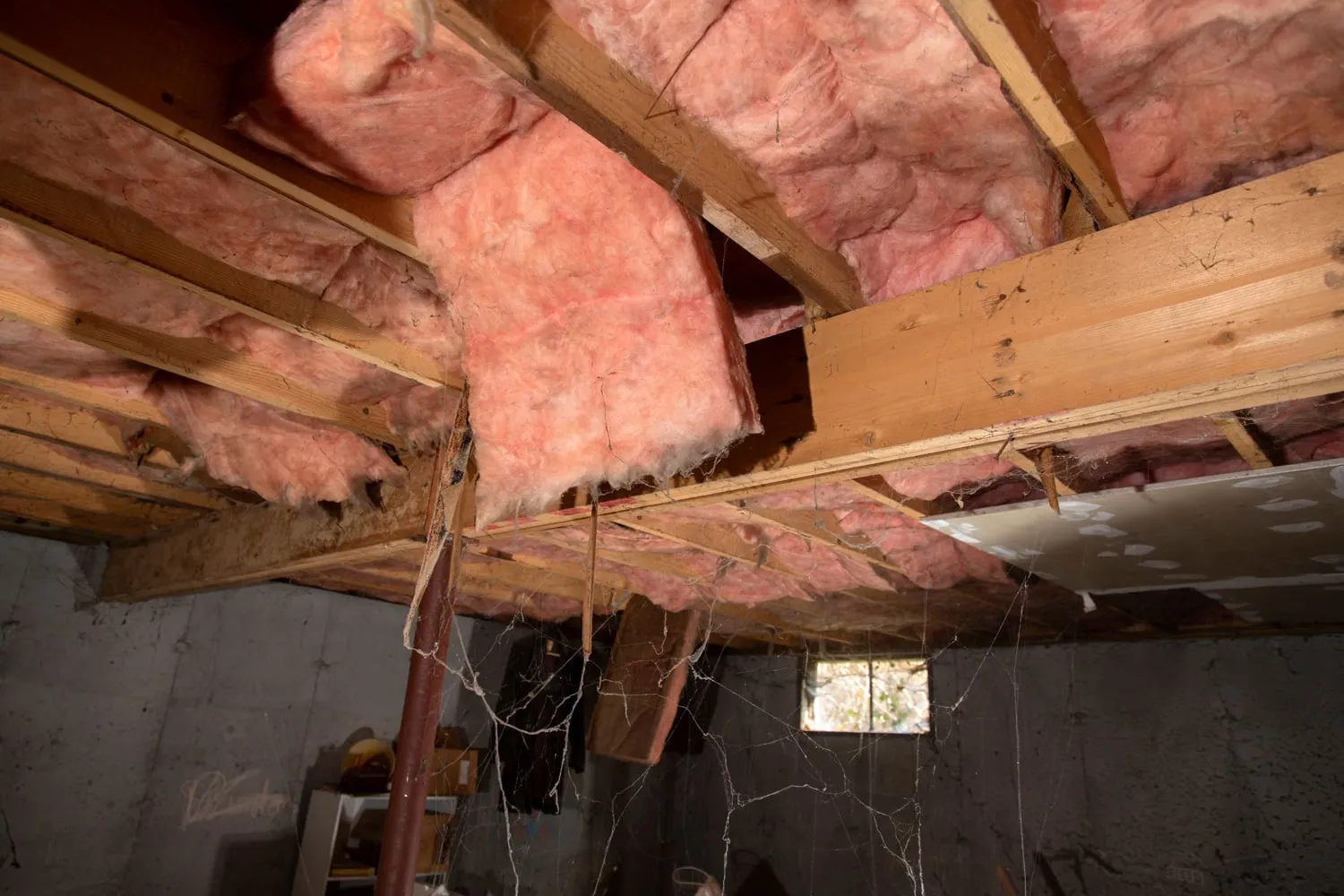
Wet fiberglass insulation does not always require replacement, but drying and reuse depend on the product, water source, condition, and ability to dry completely. Batts that are contaminated, damaged, or unable to recover their intended thickness need a different response from clean, briefly damp material.
The wall or ceiling around the insulation also matters. Dry-looking drywall does not establish that concealed materials are ready to cover, and replacing insulation does not fix the leak that made it wet.
Before deciding what to save, establish where the water came from and what it affected. This guide explains how to assess wet fiberglass insulation, recognize related problems, and plan the work before new drywall hides the cavity.
Why Did the Insulation Get Wet?
Start with the event that brought the problem to your attention. Was there a roof leak, a plumbing failure, wind-driven rain near a window, or dampness with no obvious incident?
Wet fiberglass insulation is a condition, not a diagnosis. The damaged area may help locate the investigation, but it does not prove that the nearest pipe or roof detail caused the problem.
Record when you first noticed the issue and whether it changes after rain or during normal household use. Photographs taken before finishes are removed can preserve useful context.
What Should Happen Before Replacement?
Have the water-entry or moisture problem investigated and corrected. If responsibility falls outside the insulation work, confirm who will complete that repair.
Replacing wet fiberglass insulation while the source remains unresolved creates the possibility of repeating the same work. Keep the leak correction and the insulation replacement connected in the project scope.
Does Fiberglass Absorb Water?
The glass fibers themselves are different from absorbent materials such as paper. However, water can remain within the insulation assembly, including between fibers and against facings or surrounding construction.
That distinction explains why wet fiberglass insulation should not be dismissed simply because fiberglass is made from glass. The condition of the entire installation matters.
Assess the facing, nearby framing, drywall, and other affected components separately. A conclusion about the fibers does not automatically establish that every adjoining material can remain.
Does Wet Fiberglass Insulation Still Work?
Fiberglass insulation provides thermal resistance partly through the air held within its structure. When water occupies those spaces, thermal performance can decline.
Some wet fiberglass insulation can recover its intended performance after complete drying if its original thickness and suitable condition are restored. That is a conditional outcome, not permission to leave every soaked batt in place.
Use the actual product requirements when deciding whether reuse is appropriate. Do not assume another manufacturer’s guidance or a different building application applies without checking.
Will It Work Again Just Because It Feels Dry?
A dry surface is not a complete assessment. The batt may remain damp elsewhere or have lost its shape, thickness, or suitability for the cavity.
For wet fiberglass insulation, the reuse decision should address both moisture and physical condition. Record what was checked rather than relying on a quick touch test.
Can Wet Fiberglass Insulation Dry Inside a Closed Wall?
The answer depends on the assembly and exposure. A concealed cavity may not have the same drying opportunity as accessible material in an open renovation area.
Wet fiberglass insulation behind drywall therefore needs an assessment of access and drying conditions. Waiting for an exterior stain to disappear does not verify the condition inside.
Ask whether selective opening is needed and what information supports the proposed approach. The decision should account for affected drywall and framing as well as the insulation.
Should You Open the Wall Yourself?
Avoid cutting blindly into a wall containing unknown wiring, pipes, or other concealed components. Arrange an appropriate inspection and agree on the access needed.
When wet fiberglass insulation is suspected, opening the correct location can be more useful than removing a large area without a plan. Document the findings before replacement work conceals them.
What If Wet Fiberglass Insulation Is Sagging or Matted?
Condition matters after the water is gone. A batt that no longer fits its intended space may leave uneven coverage or gaps.
Wet fiberglass insulation should be checked for displaced sections, damaged facing, and loss of intended thickness. Do not assume that drying alone corrects every installation problem.
The assessment should distinguish material that can be appropriately retained from sections that need replacement. Existing coverage elsewhere in the cavity should also be reviewed.
Can You Push the Material Back Into Place?
Repositioning is useful only if the product remains suitable and can be installed correctly. Forcing a damaged batt into the cavity does not establish that its intended performance has returned.
If wet fiberglass insulation is replaced, select material that suits the cavity dimensions and project requirements. Avoid solving a fit problem by tightly packing extra material into the space.
Does Wet Insulation Mean There Is Mold?
Dampness does not prove that mold is present. Equally, the absence of an obvious surface patch does not establish that every concealed material is unaffected.
An inspection of wet fiberglass insulation should consider staining, odors, exposure history, and the condition of adjoining surfaces. Color alone is not a reliable diagnosis.
Where contamination is suspected, have the appropriate professional evaluate the affected area. Do not treat painting over a stain or masking an odor as confirmation that the issue is resolved.
Can You Spray the Batts and Keep Them?
Do not assume that applying a cleaner makes affected insulation suitable for reuse. Product compatibility, contamination, access, and surrounding materials still require consideration.
For wet fiberglass insulation with suspected contamination, establish the appropriate handling and removal plan before disturbing it. Insulation installation and contamination remediation may require different expertise.
Is Floodwater Different From a Small Clean-Water Leak?
Yes. The source and condition of the water affect the response. Sewage, floodwater, and other potentially contaminated water require a different assessment from a limited incident involving a known clean source.
Wet fiberglass insulation exposed to contaminated water should not be treated as a routine drying project. Engage a professional experienced with that type of building damage.
Tell the contractor what happened, including uncertainty about the source. A clear history helps prevent a reuse decision based on an incorrect assumption.
Should Damp Insulation Be Covered With New Drywall?
Closing the cavity should be a separate decision from finishing the leak repair. The source may be corrected while materials still need attention.
Before covering wet fiberglass insulation, establish whether it will be removed or retained and how the affected assembly will be checked. Include framing and other materials in that review.
This is particularly important when different contractors handle drying, insulation, and drywall. Each needs to know what has been completed and what remains unresolved.
What Should the Pre-Drywall Check Include?
Confirm the approved insulation product, intended coverage, fit around obstructions, and condition of retained materials. Document relevant findings before the cavity becomes inaccessible.
When wet fiberglass insulation has been part of the project, keep the moisture-related checks with the repair records. Photographs help show the location, but they do not replace appropriate verification.
Dry or Replace: What Changes the Decision?
A useful assessment considers several conditions together. No single photograph, stain size, or generic waiting period can settle every case.
| Condition | Question to resolve | Practical next step |
|---|---|---|
| Limited exposure from a known clean source | Can the product dry completely and retain its intended condition? | Review product guidance and site conditions |
| Soaked material in a concealed cavity | Is adequate drying access available? | Assess whether opening or removal is needed |
| Sagging, damaged, or poorly fitting batts | Can suitable thickness and coverage be restored? | Define retention or replacement boundaries |
| Suspected contamination | What handling and remediation are appropriate? | Obtain qualified assessment |
| Recurring dampness | Has the contributing moisture source been resolved? | Investigate before reinstatement |
| Drywall replacement already planned | What should be inspected while access is available? | Coordinate the cavity review before closure |
Use this comparison to organize questions about wet fiberglass insulation. It supports an informed inspection rather than a one-size-fits-all instruction to save or discard everything.
Does All Wet Fiberglass Insulation in a Room Need Replacement?
A localized leak does not automatically mean every cavity has been affected. However, the visible stain does not necessarily define the complete exposure area.
For wet fiberglass insulation, agree on how the affected boundary will be established. Retained sections should have a clear reason for remaining.
Ask how the contractor will handle additional findings after selective removal. This avoids confusion if the initial estimate needs to change once concealed conditions become visible.
What Affects Wet Fiberglass Insulation Replacement Costs?
Cost depends on more than the amount of new fiberglass. Access, removal, disposal, surrounding repairs, and the work needed before reinstatement can all influence the scope.
A quote for wet fiberglass insulation should distinguish material replacement from leak repair, drying, contamination-related work, and drywall restoration.
Compare what each proposal includes rather than using a generic square-foot price. A lower total may cover a different boundary or leave associated work to another contractor.
How Can You Prevent the Same Problem Returning?
Prevention starts with resolving the identified moisture source. Keep records of the original findings and the corrective work so future changes can be compared.
After wet fiberglass insulation is addressed, monitor the location for renewed staining, odors, or other changes. Report recurrence promptly instead of waiting for another decorating project.
Avoid automatically adding a vapor-control layer without reviewing the assembly. Its suitability and placement depend on the construction and applicable project requirements.
For a renovation in Ocean County, NJ, coordinate the insulation plan with the surrounding wall or ceiling design. The material should fit the project rather than be chosen solely because it was used elsewhere in the home.
What Should You Ask Before Replacing Wet Fiberglass Insulation?
Start by confirming the repair sequence: source correction, assessment of affected materials, any necessary removal or drying, insulation installation, and finish restoration.
For wet fiberglass insulation, clarify who makes the reuse decision and what information supports it. Establish who is responsible for any specialist work outside the insulation contractor’s scope.
Keep a written record of the affected locations, selected products, included finishes, and approval process for additional discoveries. Clear responsibilities reduce the chance of an unfinished task being hidden by the next stage.
Frequently Asked Questions
Can Wet Fiberglass Insulation Be Reused?
Sometimes, if the product guidance allows it, the water was suitable for a salvage assessment, and the material dries completely while retaining its intended condition. Reuse should be confirmed for the actual installation.
How Long Does Fiberglass Insulation Take to Dry?
There is no reliable universal drying time. The amount of water, access, surrounding materials, and drying conditions vary. Ask what verification is needed rather than accepting a fixed number of days as proof.
Does Wet Fiberglass Insulation Always Need Immediate Removal?
The response depends on exposure and condition. Assessment should begin promptly, but the removal decision needs to account for contamination, drying access, product guidance, and adjoining damage.
Can a Ceiling Look Dry While the Insulation Is Damp?
Yes. The exposed finish and concealed cavity can have different moisture conditions. A disappearing ceiling stain does not verify that the insulation and surrounding materials are ready to remain.
Can Wet Fiberglass Insulation Cause a Musty Smell?
A musty smell near affected construction warrants investigation, but it does not identify the source by itself. Review the entire affected area rather than assuming the fibers are the only material involved.
Will Adding New Batts Over Damp Material Help?
Adding material does not resolve the condition of the existing installation. Assess and address the affected insulation and moisture source before adding or replacing coverage.
Is Blown-In Insulation a Better Replacement After a Leak?
Changing insulation type does not fix the leak. The replacement choice should reflect the cavity, access, performance requirements, and installation plan after the moisture issue has been resolved.
Should I Replace Insulation Just Because It Is Old?
Age alone does not establish that replacement is necessary. Condition, coverage, suitability, and any damage are more useful considerations when reviewing an existing installation.
Can Wet Fiberglass Insulation Be Saved if the Facing Is Damaged?
The facing and batt need to be assessed as part of the intended assembly. Confirm whether the product can be appropriately retained or whether replacement is the clearer option for that location.
Who Should Assess Damp Batts Before Drywall Repair?
Coordinate with an insulation contractor and whoever is responsible for moisture correction or restoration. Suspected contamination may require additional specialist assessment before ordinary insulation and drywall work continues.
Resolve the Moisture Before Restoring the Finish
Wet fiberglass insulation needs a decision based on the water source, material condition, and surrounding assembly. Some products may be retained under suitable conditions; other situations require removal and replacement.
Before new drywall closes the space, confirm what has been corrected and what has been checked. A clean finished wall is the final stage of the repair, not evidence that every concealed issue was resolved.
Luma Drywall provides fiberglass batt insulation and drywall services for residential and commercial properties in New Jersey. Homeowners in Ocean County can call (732) 300-0279 to discuss the insulation and finish-restoration work their project needs.